
If you’ve looked into AI photo booths recently, you’ve probably seen the idea of group AI photos mentioned a lot. It sounds simple on the surface, but in real events, group photos behave very differently from solo ones. Lighting changes, people move, someone always steps half out of frame, and suddenly the output looks inconsistent or awkward.
That’s where group filters come in. They are not just “the same filter, but for more people.” They are designed specifically for how groups actually behave at live events, and for the kinds of moments brands want guests to remember and share.
Before deciding whether to use them, it helps to understand what group filters are, what they are not, and when they make sense in a real event environment.
Why group photos are harder than they look
At most events, guests rarely arrive alone. People come with friends, coworkers, partners, or entire teams. Naturally, they want photos together.
Traditional photo booths handle this by just widening the camera view. AI systems are different. The AI needs to detect faces, understand positions, and apply a consistent style to everyone at once. When a system is built mainly for solo portraits, group photos can quickly fall apart.
Common problems include uneven styling between people, faces that look over-processed compared to others, or compositions that feel cramped and unbalanced. In a live event setting, you don’t have time to fix these issues manually. Guests expect something that works the first time.
Group filters exist because of these constraints, not because of a creative trend.
What group filters actually are
Group filters are AI photo filters that are designed from the start to work with multiple people in the frame. Instead of treating a group as several separate individuals, the AI processes them as one scene.
In practice, this means a few important things. The filter expects multiple faces and balances the styling across them. It handles spacing and framing more generously, so people don’t feel cropped or distorted. It also avoids effects that look impressive on one face but become distracting when repeated across five or six people.
In Magipic, group filters are part of the broader filter library and follow the same rules as other filters. They are controlled, pre-defined experiences designed for events, not experimental tools. Guests simply choose a filter and take the photo. They are not adjusting prompts or tweaking styles on the fly.
What group filters are not
It’s just as important to be clear about what group filters are not, especially because AI marketing often blurs these lines.
Group filters are not face swaps. They do not paste faces onto unrelated bodies or scenes. The goal is to create a stylised version of the real group photo, not to replace people with something else.
They are also not free-form AI art tools. Guests cannot type in their own ideas or experiment endlessly. The look and behaviour of the filter is decided in advance so it stays appropriate for a public, branded environment.
Finally, group filters are not meant to “fix” chaotic situations. If ten people rush into frame at once in poor lighting, there are still limits. Group filters are built to handle realistic group sizes and behaviour, not to override physics or event flow.

When group filters make sense at an event
Group filters are most useful when group photos are a natural part of the event, not an exception.
Corporate events are a good example. Teams often want photos together, especially if they don’t see each other often in person. A group filter can give them a consistent, branded look without slowing down the line or requiring instructions.
Brand activations also benefit from group filters when the experience is social by design. If the activation encourages friends to participate together, group AI photos feel more natural than asking people to split up for individual shots.
Weddings, private parties, and celebrations are another strong fit. Guests tend to move in clusters, and group photos are often the most shared after the event. A filter that handles three to six people comfortably will get used far more than one designed only for solo portraits.
On the other hand, if your event is structured around fast individual throughput, group filters may be less important. In those cases, a small set of strong solo filters might be the better choice.
How group filters affect event flow
One reason group filters are often misunderstood is that people think they automatically slow things down. In reality, well-designed group filters usually do the opposite.
When guests want group photos but the system isn’t designed for them, they tend to retake photos repeatedly. People step in and out, try again, or abandon the experience altogether. That creates friction and queues.
A group filter sets expectations. Guests see that the experience is meant for groups, they step in together, take the photo, and move on. Fewer retries means smoother flow, even though more people are involved per session.
This matters especially at busy events where staff cannot manage the booth continuously.
Brand safety and consistency in group AI photos
From a brand perspective, group photos are higher risk than solo ones. There are more faces, more expressions, and more chances for something to look off.
Group filters are usually more conservative by design. They avoid extreme transformations and focus on clean, flattering results that work across different ages, skin tones, and expressions. This is intentional.
In a branded environment, consistency is often more valuable than surprise. A group photo that looks cohesive and on-brand will be shared more confidently than one that feels unpredictable.
Group filters and guest expectations
Guests don’t usually think in terms of “filters” or “AI logic.” They think in terms of moments.
If people approach the booth as a group and the experience pushes them toward individual photos, it feels slightly wrong. Conversely, when the system clearly supports group photos, guests feel understood.
This alignment between expectation and experience is subtle, but it has a real impact on engagement. People are more relaxed, they smile more naturally, and they are more likely to share the result.
Choosing how many group filters to offer
More is not always better. At live events, too many options can slow people down.
Many successful events offer just one or two group filters alongside a small set of solo ones. This gives guests a clear choice without overwhelming them. The goal is not to showcase the entire library, but to match the filters to how people will actually behave.
Because Magipic filters are controlled experiences, customers decide what is available at each event. This curation is part of what keeps the experience reliable.
You can try out Magipic.ai's group filters by signing up for a free plan.
Where group filters fit in the bigger picture
Group filters are not a special feature added for novelty. They are a response to how real people behave at real events.
If your event is social, collaborative, or celebratory, group AI photos will likely be a core part of the experience. If your event is highly individual and fast-paced, they may play a smaller role. The important part is making that decision intentionally, rather than assuming one setup fits all.
Understanding when and why to use group filters helps you design an AI photo experience that feels natural, reliable, and genuinely enjoyable for guests.
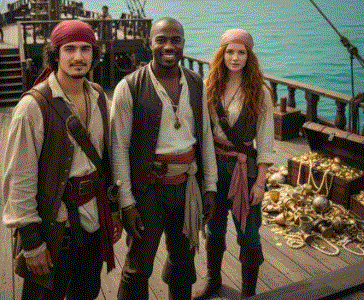
What are group filters and when should you use them?
Oct 4, 2025
Filters & Styles
FAQs
What are group filters in an AI photo booth?
Group filters are styles designed to work well when multiple people appear in the same photo. They are structured to handle positioning and composition across several faces.
Do group filters work differently from single-person filters?
Yes. Group filters are optimised to maintain visual consistency across multiple guests within one image.
Are group filters suitable for large team events?
Yes. They are especially useful at corporate gatherings, brand activations, and social events where guests participate in groups rather than individually.
What Are Custom Filters in Magipic.ai?
Custom AI filters don’t mean guests can do anything they want. Here's what custom filters are in Magipic, how they work at real events, and why control matters when you’re running AI in public.
What “branding” actually means in an AI photo booth experience
A clear explanation of how branding works in AI photo booth experiences, beyond just adding a logo.
How AI filters work at live events (and who actually controls them)
What AI filters really are at events, and why control matters more than unlimited creativity.